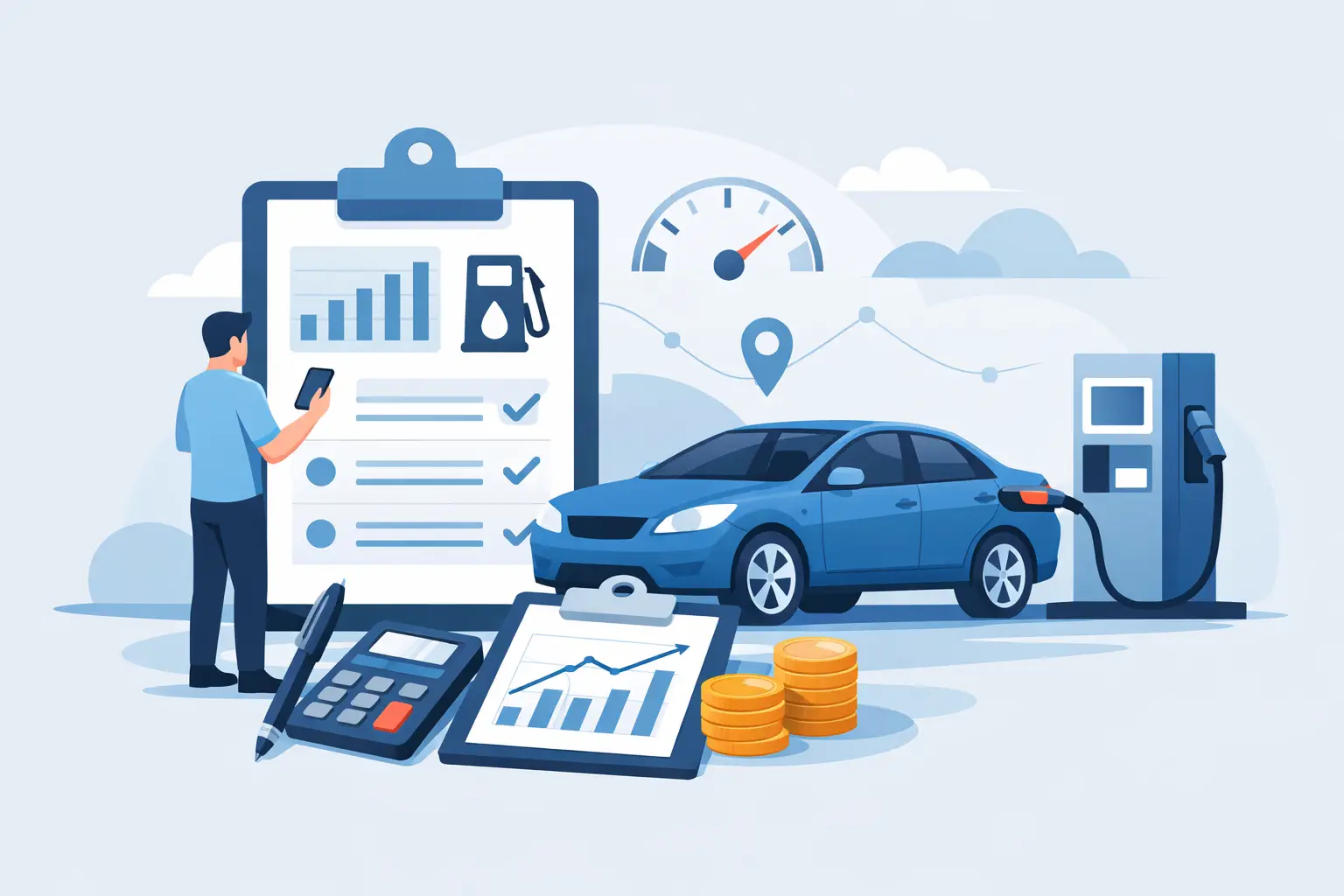
Operating Cost Guide for Your Vehicle

Fuel prices climb, a tire replacement pops up, and by month's end, it seems your vehicle burned through more money than expected. The problem isn't just spending: it's not knowing exactly where, when, and why. This operating cost guide helps you turn scattered expenses into useful information so you can better care for your car, motorcycle, van, or truck.
For those who use their vehicle daily, this control prevents surprises and helps plan maintenance. For app-based drivers, delivery workers, and small business owners, it also provides a crucial answer: after all expenses, what actually remains?
What is vehicle operating cost
Operating cost is the amount needed to keep a vehicle running during a specific period. Usually, the calculation is made monthly or per kilometer, because these two views answer different questions.
Monthly cost shows how much the vehicle weighs on your budget, even when it sits idle. Cost per kilometer reveals how much each trip, delivery, ride, or work visit actually costs. Anyone who works with a vehicle needs to track both.
There's no standard number that applies to everyone. A car used only on weekends has a very different expense structure than a delivery motorcycle. Similarly, a service van might drive less than a rideshare car, but have more expensive parts, insurance, and maintenance.
The goal isn't to cut every expense at any cost. It's to distinguish necessary spending from waste, anticipate what's coming, and make safer decisions.
Operating cost guide: what to track
Control only works when it includes recurring expenses and those that appear only a few times per year. A service delayed for months still counts as a vehicle cost, even if you were only charged once.
Fuel and consumption
Fuel is usually the most visible expense, but recording only the amount filled leaves the analysis incomplete. Note the date, mileage, liters, price per liter, and total cost. With this data, you can monitor average consumption and spot changes before they turn into bigger losses.
If a car used to get 11 km/liter and now gets 9 km/liter on the same route, it's worth investigating. It could be traffic changes, incorrect tire pressure, low-quality fuel, worn tires, or maintenance needs. Without history, any diagnosis is just a guess.
For professionals, it's also useful to separate fuel purchased during work from personal driving. This prevents profitability from appearing worse or better than it really is.
Preventive and corrective maintenance
Oil, filters, fluids, alignment, balancing, brakes, battery, tires, and belts are all part of operating costs. Recording each service, the mileage, and the supplier creates a history that makes the next decision easier.
Preventive maintenance seems like an expense that can wait, especially when the vehicle is still running well. In practice, delaying an oil change or ignoring a noise can turn a planned expense into an expensive breakdown. For those who depend on their vehicle for work, a day without it also means lost income.
Corrective maintenance deserves its own category. This way, you can compare how much was spent preventing problems versus how much was spent fixing failures. If repairs start to repeat, it might be time to review your driving habits, the quality of parts, or even whether keeping that vehicle makes sense.
Registration, insurance, and fixed expenses
Registration fees, licensing, insurance, vehicle protection, financing, tracking, monthly parking, and garage rental don't disappear when the vehicle sits idle. These are fixed costs and should be included in your monthly calculation.
A simple way to avoid distortions is to divide annual payments by 12. If insurance costs $2,400 per year, count $200 per month. This way, renewal month doesn't seem artificially expensive, and you can set aside the money in advance.
Those working with passengers, deliveries, or field service should also include platform fees, frequent washing, internet used for work, required accessories, and any service needed to keep operations running.
Depreciation and less obvious costs
Depreciation is the loss of vehicle value over time. Not every driver needs to calculate this with absolute precision, but ignoring it can create a false sense of profit, especially in professional activities.
A simple example: if a vehicle is worth $50,000 today and, after a year of heavy use, is worth $43,000, there's been a $7,000 loss in value. This amount doesn't leave your checking account like a fuel purchase, but it's part of the cost of using that asset.
Also consider fines, tolls, car washes, parking, accessories, tires, and bank fees. They may seem small individually, but they add up quickly when not tracked.
How to calculate monthly cost and cost per kilometer
After recording expenses, choose a consistent period, such as the last three or six months. A single month might include a tire replacement or major service and not represent the vehicle's true routine.
To find your monthly operating cost, add all expenses for the period and divide by the number of months. For example, if total spending over three months was $6,000, the average monthly cost was $2,000.
To calculate cost per kilometer, use this formula:
operating cost per km = total expenses for the period ÷ kilometers driven in the period
If the same $6,000 was spent to drive 12,000 km, the cost was $0.50 per km. This number helps you price services, evaluate a route, and decide whether a particular trip is worthwhile.
The calculation becomes more reliable when mileage is recorded at every fuel stop and service. Memory estimates often produce errors, especially in shared vehicles or those used by multiple drivers.
How to use the numbers to make better decisions
The final number matters, but comparing over time is even more valuable. An increase in cost per km might indicate lower fuel efficiency, accumulated maintenance, or less efficient use. A decrease might show that a maintenance routine, a different route, or more careful driving is paying off.
For the professional driver, compare your cost per km with your revenue per km. If you earn $2.00 per km and your vehicle costs $0.80 per km to operate, you still have taxes and other personal costs before calling the rest profit. This care prevents accepting work that generates high revenue but low margin.
For families, the history shows whether keeping a second vehicle still makes sense. For small fleets, it helps identify which unit is demanding too much maintenance, burning fuel above normal, or sitting idle frequently.
It's also worth creating practical goals. You can set an expected consumption range, reserve a monthly amount for tires and maintenance, or review costs on the same day each month. Simple goals are easier to maintain than complex spreadsheets abandoned after two weeks.
Centralize your history to stay on top of things
Receipts in the glove box, notes on your phone, and amounts jotted down in conversations make tracking exhausting. The ideal is to have a single record for fuel, services, expenses, documents, mileage, and maintenance reminders.
With an app like Mine Garage, you can record each event as it happens and review your vehicle's history without relying on memory. This is useful whether you own a single motorcycle, share cars, manage a small fleet, or need to separate work and personal expenses.
Don't try to reconstruct years of spending in an afternoon. Start with your next fuel stop, your next service appointment, and your most important fixed expenses. After a few months of consistent records, your vehicle stops being a source of surprises and becomes an operation you truly understand.